

A few months ago, as part of the "Projects III" course in my Data Science degree, we became involved in a collaborative project with PricewaterhouseCoopers. They asked us to do a project on the topic of "Social Listening," without giving us any further instructions. Therefore, we spent the last five months meeting with them and establishing a common goal: to design an architecture for social listening that, simply by indicating the company name, it would collect the data, process it, and deliver it to us brand insights ready to present.
And that's how this project was born, which I developed together with my inseparable friends. Adrian Castillo, Carlos Serrano.
In this post we tell you how we did it, what we discovered by analyzing Apple, and what lessons we learned for future projects. social network analysis.
The challenge: listening without supervision
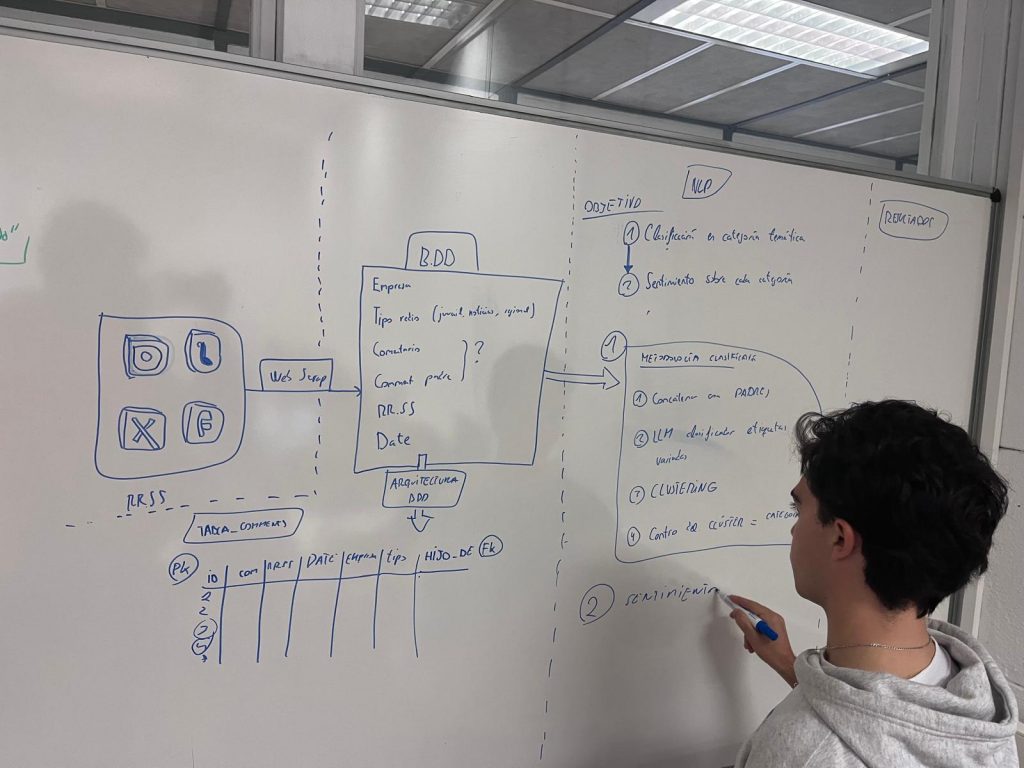
Our goal was clear: automate end-to-end the process of social listening and reducing the hours spent on manual setup and cleanup. To achieve this, we defined four milestones:
- Capture without API
We developed a module of web scraping with Playwright that simulates the behavior of a real user and avoids the usual blocks (rotation of User-Agent, (random times, etc.). This way we extract public comments from any network without special credentials. - Dynamic thematic labeling
Instead of classifying with fixed lists, we use a local LLM (Llama 3 8B) that assigns each comment a 1-3 word label. We then group these labels using HDBSCAN and embeddings to discover the latent themes that worry the audience. - Sentiment and online reputation score
We apply a model to each comment. Transformer multilingual system that decides whether the tone is positive, negative, or neutral. With that signal, we calculate a Social Score by topic (-1 to +1) which allows us to compare quickly. - Instant display
React + Tailwind generate a dashboard that auto-completes when the pipeline: global metrics, time evolution and a 3D map of topics to navigate the conversation.
In total, the flow takes about 10 min Downloading 1,000 comments and tagging them with AI takes one hour on a standard CPU; all scalable if we switch to GPUs or parallelize processes.
Data and period analyzed
For the proof of concept we focused on TikTok (due to its volume and colloquial language) and we traced mentions of “Apple” among July 2022 and May 2025. The result was 45,000 comments ready for analysis.

Key findings: Apple under the microscope
We share the insights more eye-catching, useful for any marketer junior-mid that you want to apply social listening in practical terms:
- Sentiment distribution
- 31 positive %, 42 neutral %, and 26 negative %. Although the brand is generating enthusiasm, there is a critical area that we should not ignore.
- Top 5 tracks by volume
- iPhone battery (Social Score –0.22)
- Apple Ecosystem (+0,35)
- Prices (–0,48)
- Privacy (+0,41)
- Design (+0,44)
- Brand insight Revealing: users applaud the integration between devices, but perceive price as the main barrier to purchase. The product team could leverage the ecosystem's competitive advantage while reinforcing value propositions to justify the cost.
- Temporary trend
During the September launches, sentiment improves to +0.12; three months later it returns to the average. Novelty campaigns work, but the effect fades quickly.
What we learned in the process
- Prompt engineering is worth its weight in gold.
Small changes to the LLM prompt involved shifting from general labels (“quality”) to very specific mentions (“M3 chip”). Investing time here increased the accuracy of the clustering. - Modularity facilitates iteration
Separate the scraping, NLP and the visualization layer allowed us to fine-tune each piece without breaking the rest. The next step will be to connect graph databases to optimize thread search. - Speed vs. depth
One hour of CPU time per 1,000 comments is acceptable for prototypes, but in production we'll need GPUs or batch processing. The good news is that the configuration savings more than offset that cost. - Online reputation ≠ volume of mentions
Sometimes a minority issue (e.g., “privacy”) carries more weight in the overall perception than the hype around a new device. Looking only at volume curves can lead to erroneous conclusions.
Conclusion and next steps
Building this pipeline has taught us that the true value of social listening It's not about accumulating data, but about delivering it. brand insights Actionable in hours, not weeks. If you're starting out in analytics marketing, our advice is automate soon Repetitive tasks to dedicate your time to interpreting results and proposing actions that improve the online reputation.
The project was so well received that PwC even invited us to their Madrid offices to present it in person. But that's another story… which I might share in the next post.
Do you want to see the full project?
Here are the documents we prepared: