
The analog ritual in a sport of hundredths of a second
Swimming is a sport obsessed with precision. We measure time in hundredths of a second, use state-of-the-art electronic timing devices, and analyze the biomechanics of the stroke with underwater cameras. However, in the 21st century, poolside management of swimmers was still stuck in the 1990s.
If you've ever been to a competition, you know the scene: heat, humidity, shouting, the smell of chlorine, and, amidst the chaos, a table piled high with papers. It's the departure lists (the "series").
The ritual is sacred: as soon as the lists are printed, the team manager or a coach grabs a highlighter and begins the hunt. Page after page, they search for the surnames of the swimmers in their club to mark them. It's the only way to quickly and visually identify when it's each swimmer's turn to jump into the water.
The trigger: 20 minutes of frustration
The idea of Yellow o'clock It wasn't born in a meeting room or in front of a programming IDE. It was born in the stands of a swimming pool.
That day, the task fell to me. «"Here, underline the team members."», They told me, handing me a stack of papers and a yellow marker.
I sat down and started searching. García… no, he's from another club. Martínez… yes, he's ours.
Five minutes passed.
Ten passed.
To the 20 minutes, He was still there, with tired eyes and ink-stained fingers.
At that moment, my developer brain clicked. I felt that mix of frustration and epiphany that all programmers know. It made no sense for a human being to be doing a task... text pattern search manually.
«"A script could do this in milliseconds. Why am I doing it?"»
That question was the beginning of everything.
From the "dirty" script to the actual product
I got home and turned on my computer. The first version didn't have a pretty interface, a website, or even a name. It was simply a Python script designed for a very specific task: PDF ingestion, text string recognition (OCR/Text extraction) and color layer overlay.
PDFs are complex files to manipulate programmatically. Unlike a plain text file, a PDF is more of a visual map than an ordered data structure. The technical challenge lay in locating the exact coordinates where the club's name appeared and "painting" over it without breaking the document's original formatting.
After struggling with several libraries and X/Y coordinates, I finally got it working. I sent it a 50-page PDF and, in less than a second, it returned the file with all my colleagues highlighted.
Luxury Beta Testers: CN Mediterráneo Valencia
Software that only you use is a script; software that others use is a product. To make that leap, I needed feedback real.
I was incredibly fortunate to have the collaboration of the board of directors of Mediterranean Swimming Club Valencia. They became my beta testers. I gave them the first versions of the program and observed.
Thanks to them I learned lessons that code doesn't teach you:
- Usability is key: Nobody wants to open a command terminal in a swimming pool. They needed a button, a drag & drop, something intuitive.
- Privacy matters: The clubs handle data on minors. Uploading the lists to an unknown cloud generated distrust. That's why I decided that Yellow o'clock would be 100% local and offline.
- Robustness: The formats of the minutes vary slightly depending on the federation. The algorithm had to become more flexible to avoid errors if the font or spacing changed.
Yellow o'clock today: Technology at the service of the user
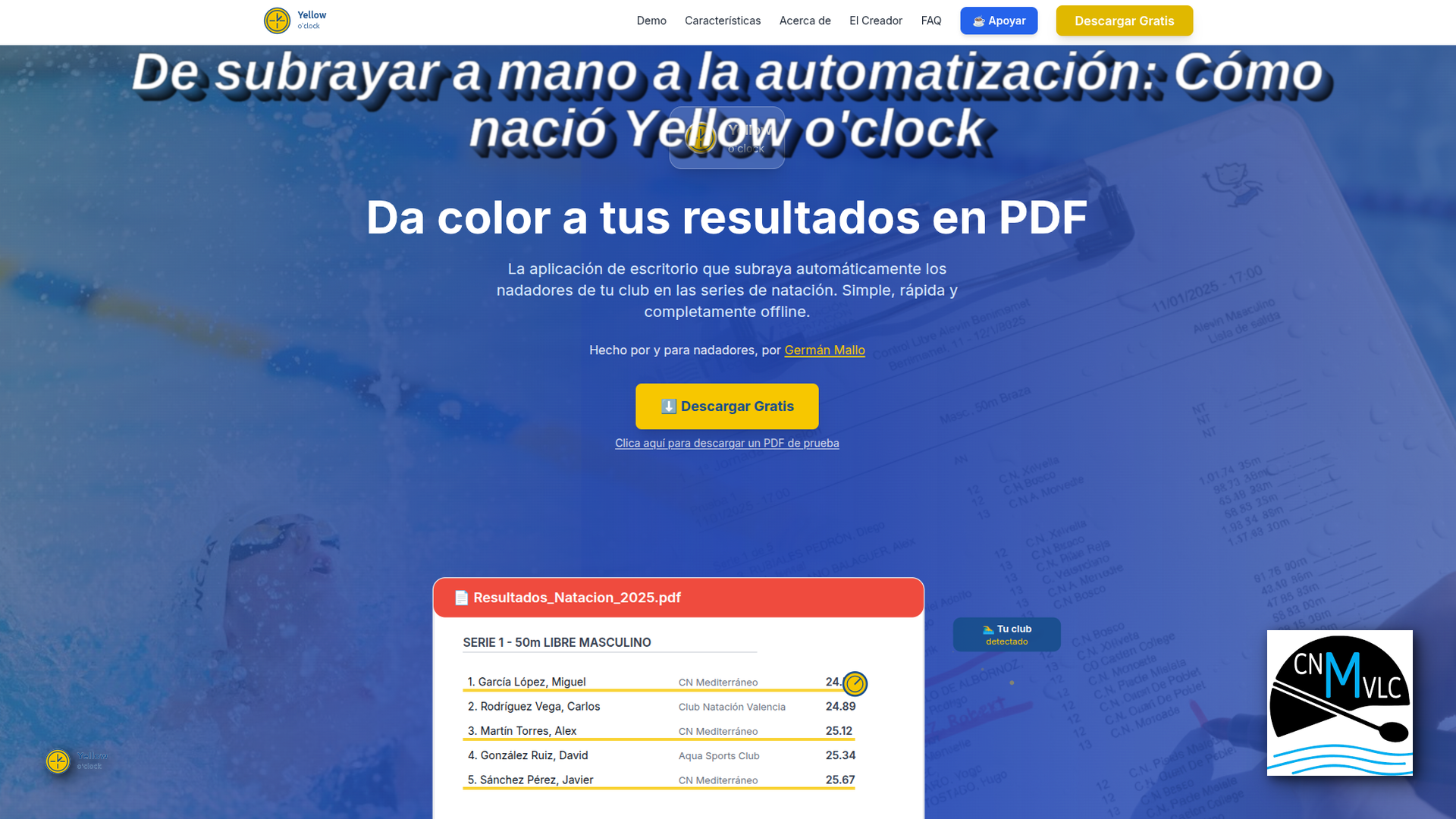
The result of those iterations is what you can see today in yellowoclock.germanmallo.com.
The project is divided into two major technological pillars that I wanted to keep Open Source:
- The Core (Python & PDF Manipulation):
The application's engine uses efficient search algorithms to scan large documents in record time.
💻 Repo: github.com/Dreiko98/pdf_remarker - The Platform (Next.js & Tailwind):
To distribute the tool, I created a modern, SEO-optimized, and accessible landing page. I wanted the download experience to be as seamless as the app itself. I used Next.js 13 with App Router to ensure maximum performance.
🌐 Repo: github.com/Dreiko98/yellow-o-clock-landing-page
Conclusion: Solving real-world problems
Often, in the world of development, we get lost searching for the perfect architecture or the latest technology. But Yellow o'clock It reminded me of the essence of our profession: create tools to make life easier for people.
What started as a way to save me 20 minutes of boredom now saves accumulated hours for delegates and coaches, allowing them to focus on what really matters: their swimmers.
If you're part of the swimming world, I invite you to try it. And if you are developer, I invite you to look at the code, fork it, and improve it.