Description
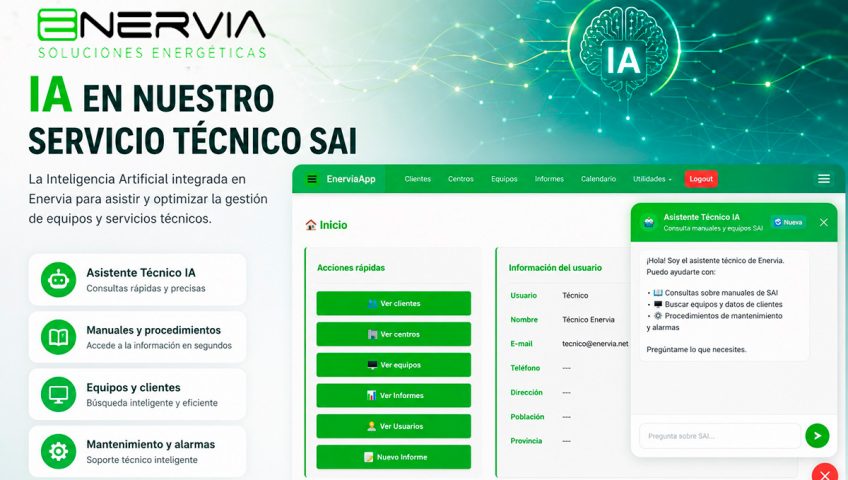
EnerviApp centralizes the operations of ENERVIA's technical service: equipment, clients, visit reports, intervention history and technical documentation.
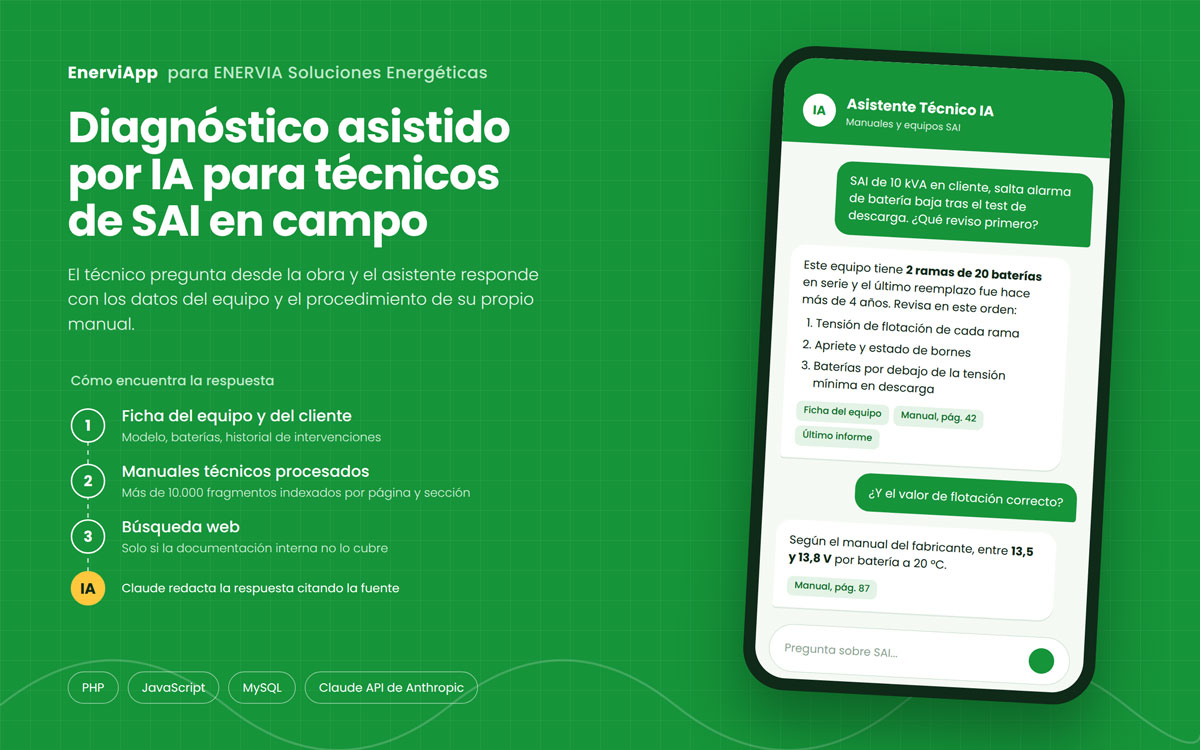
On that platform I developed an artificial intelligence assistant capable of responding to the technician from the installation itself using real information from the equipment and the available documentation, instead of just generating a generic response.
01 — Understand
The problem wasn't finding information. It was finding it in time.
A technician may find themselves in front of a UPS with an alarm and have all the information necessary to resolve it: equipment data sheet, installed batteries, previous interventions and hundreds of pages of manuals.
The problem is locating The right information in a few seconds, especially during an intervention.
The need was clear: to allow the technician to ask questions naturally and receive an answer based on the actual information available to that team.
Need: Reduce the time spent consulting manuals and historical records during an intervention.
02 — Choose
AI, but with context and sources.
The key decision was not to build a generic chatbot.
The assistant consults the information following a hierarchy of sources:
1. Team and client
Model, battery configuration, history and previous interventions.
2. Technical documentation
More than 10,000 fragments of manuals processed and indexed by page and section.
3. Web
Only when internal documentation does not contain sufficient information.
In that context, Claude generates the response indicating diagnosis, procedure, reference values, and source used.
03 — Build
From technical data to a useful answer in the field.
The system was integrated directly into EnerviApp so that the technician can consult the assistant without leaving their workflow.
The application combines structured MySQL information with pre-processed technical documentation and contextual retrieval before sending each query to the model.
The result is a tool capable of answering questions such as:
“10 kVA UPS at customer's premises, low battery alarm after discharge test. What should I check first?”
and automatically relate them to that specific equipment, its configuration, its history, and the corresponding manual..