
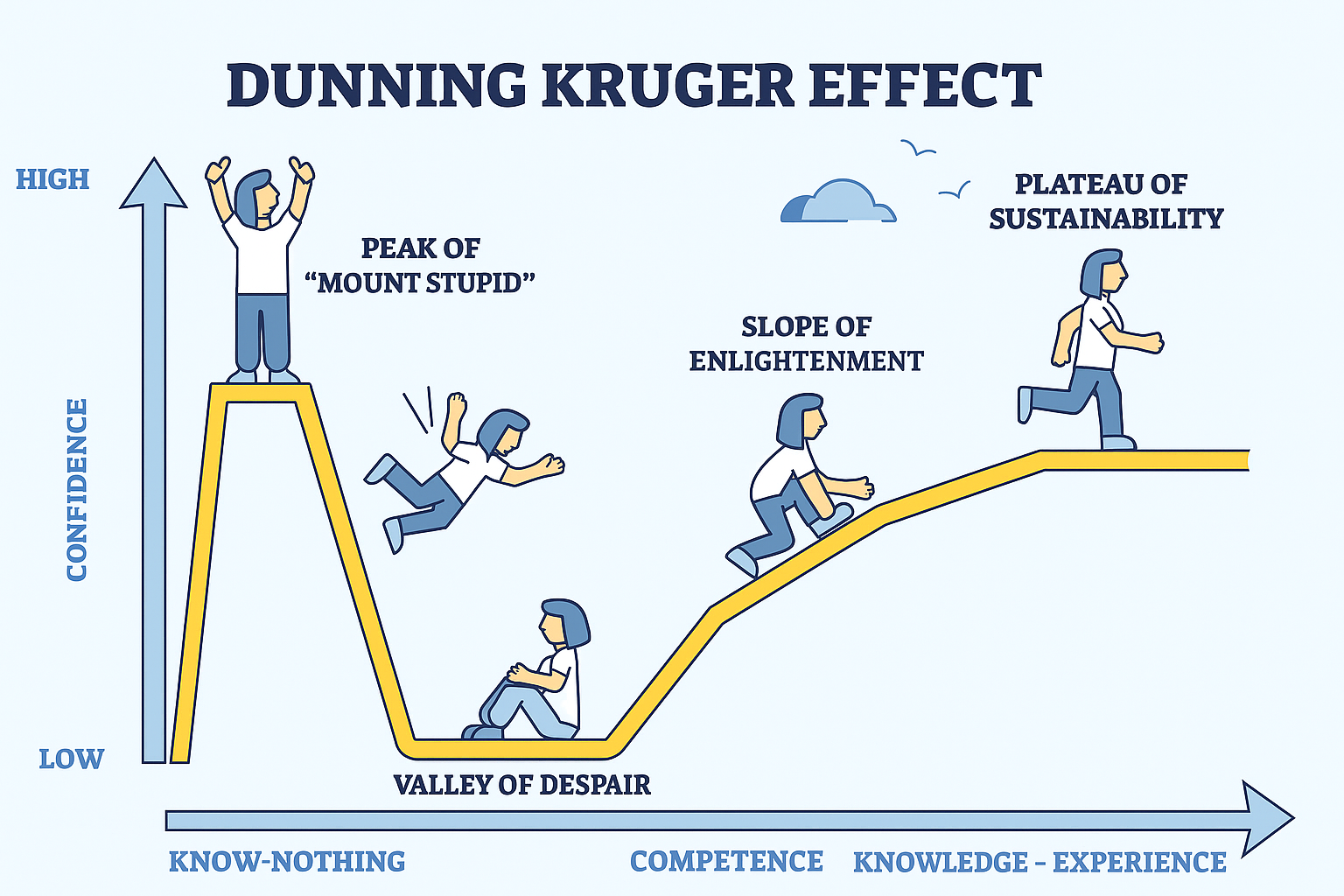
Have you ever learned something only to realize you didn't really know it as much as you thought? That's one of the key aspects of the Dunning-Kruger effect, and the good news is that if you're feeling insecure or experiencing the infamous "imposter syndrome," you might be on the right track. In this post, we explore why those who least know They often think they know everything, so why do those who more they know They tend to doubt, and how to take advantage of that to grow.
What is the Dunning-Kruger effect?
The Dunning-Kruger effect is a cognitive bias whereby people with little competence in an area tend to overestimate their abilities.
According to psychologists David Dunning and Justin Kruger, this overestimation is partly due to inexperienced people lacking the metacognition needed to see their own limitations.
In contrast, those with a high level of competence tend to underestimate their abilities, precisely because they understand the complexity of the subject and know what they don't know. (Mind and Calm)
The “curve” of trust vs knowledge
Let's visualize what happens: at the beginning of our learning, when we know very little, our confidence can skyrocket. We feel knowledgeable because we've grasped the basics. But then, as we delve deeper, we discover how broad and complex the subject is, and our confidence drops or levels off—even though our actual knowledge increases. Finally, we might reach a more mature level where there's a balance between competence and self-awareness. This mature phase is less about a "confidence boost" and more about grounded humility.
This pattern is what is often called the “Dunning-Kruger curve”.Very Interesting)
Why do those who know more doubt more?
- When you discover what you don't know, A new learning panorama opens up: you realize that the subject is bigger than you imagined.
- Having experience and knowledge involves recognizing cases, exceptions, variations… which makes your own estimate more cautious.
- On the other hand, if you have little knowledge, you don't see what you lack, and therefore you may believe that with what you know you already "control it".
So: feeling that you don't know as much as you thought It's not a failure, it could be a sign that you're making progress.
Imposter syndrome as a sign of being on the right track
The so-called Impostor Syndrome refers to the feeling that your achievements are undeserved, or that at any moment you'll be "exposed" as someone who doesn't know as much as you think. But precisely, if you realize that the topic has many facets, that others can ask questions you don't know the answers to, or that learning is continuous… you're in a healthy place.
In other words, doubting your expertise is a sign of intellectual humility, not necessarily incompetence. And that's something you can use to keep learning and improving.
What to do with this awareness?
Here are some practical recommendations to transform restlessness into a driver of growth:
- Maintain a beginner's mindsetEven if you already know a lot, adopt the attitude that you still have much to discover.
- Request feedbackAsk colleagues or mentors to give you honest feedback on areas for improvement.
- Document what you don't knowMake a list of topics, questions, or doubts that arise in each learning phase.
- Celebrate achievements, acknowledge limitationsRecognize what you do know, but keep an eye on what you don't know.
- Check your progress regularlyGo back to the beginning of your curve: were you overconfident without a solid foundation? Now, compare that to where you are now.
- Turn doubt into curiosityInstead of seeing doubt as a negative sign, use it as a spark to explore new paths.
Practical applications in management, work, and personal development
- In a work team: the members who think they are the most clever may overlook errors or risks; those who doubt may contribute more valuable questions.
- In training: a trainer who thinks he knows everything can stop learning, while someone who knows what he doesn't know continues to evolve.
- In product or entrepreneurship: recognizing that "we don't master everything" opens us up to innovation, collaboration and exploration, which is in line with a culture of continuous improvement.
Conclusion
The next time you catch yourself thinking, “Do I really know this as well as I thought?” or “Why do I have doubts if I’ve been doing this for so long?”, remember: that might be fair. the signal that you're making progress. On the learning curve, those who don't know much tend to be very confident; those who know a lot tend to be more attentive to what they don't know.
So, embrace that humility, keep your curiosity alive, and turn imposter syndrome into your ally to keep growing.