
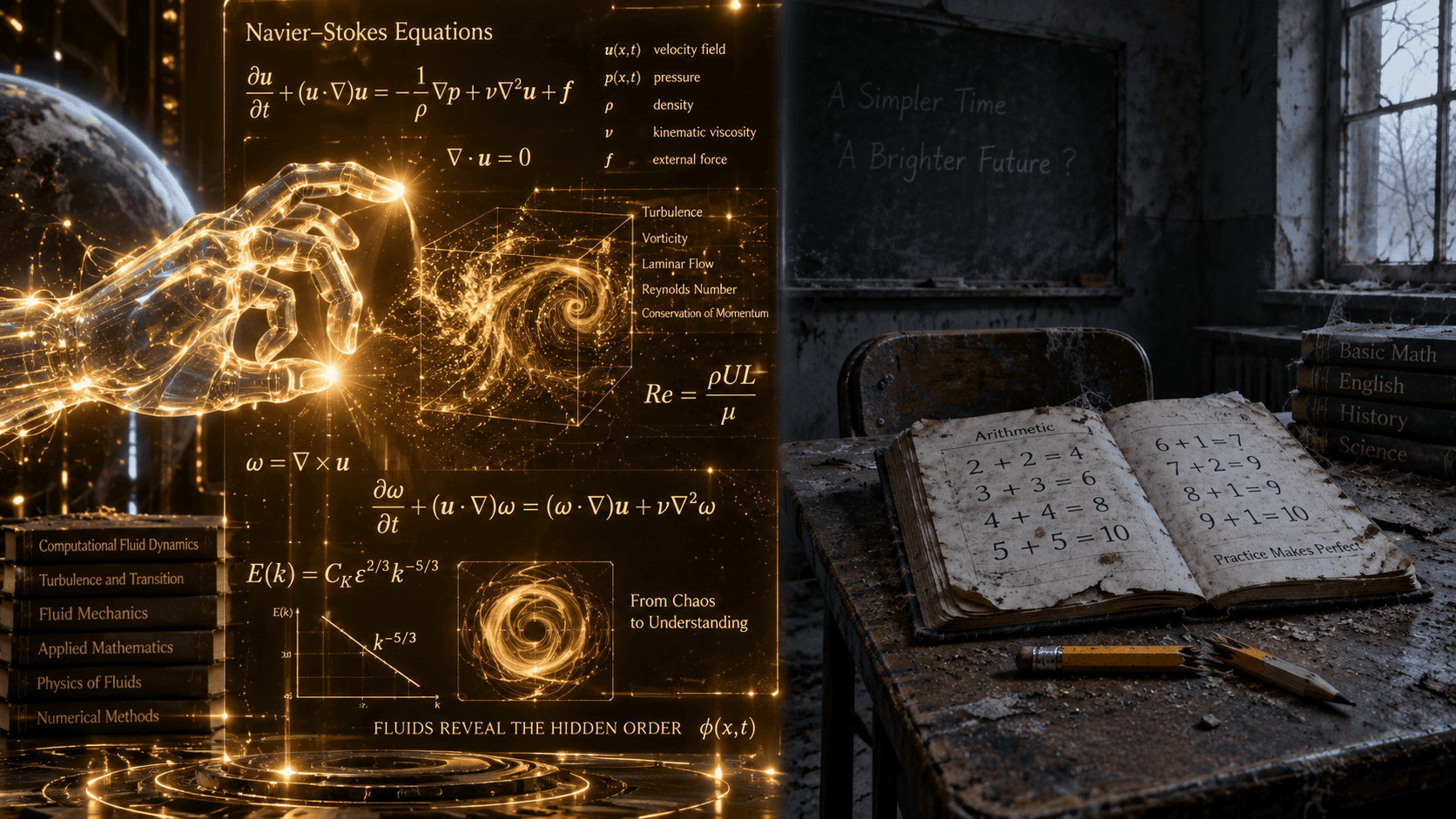
Yesterday, two headlines appeared that, read fifteen minutes apart, seem like a dark humor joke about the future of our civilization.
On the one hand, OpenAI announced that it had found a solution to the Navier-Stokes equations, One of the famous seven Millennium Problems that had eluded the brightest minds in history for over a century. Thousands of coordinated artificial intelligence agents solving in hours what took humanity generations.
On the other hand, the latest update popped up. PISA report in Spain. The diagnosis surprises no one who walks the streets: reading comprehension is at rock bottom, mathematical thinking is in free fall, and overall results are worse than a decade ago.
The machine breaks historical records in calculation and abstract reasoning. Society regresses in its ability to understand a three-paragraph text or formulate a rule of three without looking at the screen.
This is no coincidence. It is a symptom of a divide that threatens to polarize the world like never before.
The paradox of the cognitive crutch
Technology has always been a lever. When we invented the wheel, we stopped carrying heavy loads on our backs; when the calculator arrived, we stopped doing long divisions by hand in accounting balances.
The problem arises when You outsource the effort that builds the structure of your brain.
As the mathematician Terence Tao so aptly observed, solving difficult problems is like going to the gym to lift weights. The important thing isn't that the bar goes up and down; it's the muscle you build during the effort. If you hire a machine to lift the bar for you, the job will be "done," but you'll leave the gym just as weak as when you went in.
During the last decade we have confused two concepts that have nothing to do with each other:
- Access to information: Immediate, infinite, in your pocket.
- Assimilation capacity: Slow, deliberate, uncomfortable, and dependent on one's own effort.
The education system has spent years eliminating the friction of learning in the name of a misguided notion of "digitalization." The PISA report is the bill we've just received for having replaced in-depth reading and deductive reasoning with fragmented screen time.
The bifurcation: those who direct the models vs. those who are directed
In this new socioeconomic context, there will be no middle ground. A brutal gap is opening up between two profiles:
- Cognitive architects: Those who understand logic, mathematical foundations, historical context, and critical thinking. This minority uses AI as a mental exoskeleton to multiply their execution and analytical capacity tenfold.
- Digital dependents: Those who never developed analytical skills and delegate to the tool not only the mechanical work, but also the judgment, are incapable of validating whether what the screen displays is genius or a coherent hallucination.
If you can't think for yourself before opening a prompt, AI doesn't make you more productive: it simply accelerates your ability to produce mediocrity without you realizing it.
The real digital divide of 2026 is no longer about having a fiber optic connection or a state-of-the-art laptop; The gap lies in the ability to concentrate, synthesize, and think critically..
How to avoid intellectual atrophy in the age of AI
This isn't about getting nostalgic, burning down servers, or banning screens in classrooms as if we were in the 19th century. Technology is here, and the landmark Navier-Stokes equations demonstrate its potential to cure diseases, optimize energy, and transform science.
But on an individual and professional level, we need to apply certain rules of mental hygiene:
- Write and outline before the prompt: Before asking a model to structure an idea, an article, or a business problem, spend 10 minutes scribbling on a blank sheet of paper. Force your brain to grapple with the concept first.
- Practice reading without distractions: If you can't read 20 pages of a dense book without looking at your phone, your attention is compromised. And without attention, there is no complex thought.
- Use AI as a sparring partner, not as an oracle: Ask it to dismantle your arguments, find flaws in your logic, or provide counterexamples. Don't ask it to think for you; use it to test your own judgment.
- Assess the value of friction: The moment you struggle to understand something isn't a flaw in the process; it's precisely where you're learning. Avoiding this by constantly taking digital shortcuts is a recipe for stagnation.
Looking at the future with a critical eye
That artificial intelligence can solve a Millennium Problem is an extraordinary technical triumph of human engineering. But that our students are leaving compulsory education with less reading comprehension than they did ten years ago is an unforgivable structural failure.
Technology will continue to accelerate at an exponential rate. The uncomfortable question we must answer as professionals, parents, and society is quite simple:
Are we going to harness this power to raise our intellectual bar, or are we going to settle for being an increasingly passive society while machines do the thinking for us?